

Trigger Stacking: the Last Straw that Broke the Camel's Back

Is your dog's reactivity inconsistent? Are they sometimes able to walk by that suspicious garbage can and other times they absolutely lose it? Are they OK at the beginning of their walk but melt down at small things by the end? Do they have good days followed by bad days and you can't figure out the pattern.
It might be trigger stacking!
What is Trigger Stacking?
Trigger stacking is when stress "stacks" on top of previous stressful experiences in order to create a disproportionate response to an individual situation.
In humans, we often call this "the last straw" or "the straw that broke the camel's back". There's only so many stressful moments that we can handle in a given period of time and when our stress levels overcome our ability to cope with that stress, we overreact. The same is true for our dogs.
Think of how you feel driving in traffic. You may be fine the first time someone cuts you off or the first time someone doesn't signal but by the 3rd or 4th time, you are probably feeling more annoyed and agitated. If it's a very stressful drive, you might even carry that stress forward - you get out of the car at home, walk inside, trip over a shoe, and lose it about the shoe. But was the shoe really the problem?
Same thing for your dog. They may be able to tolerate a lot of stressful incidents but when it's too much, they have a meltdown.
It is important to note that trigger stacking does not vanish as soon as the walk is over. Some dogs (and humans) carry their stress for several days. I haven't been able to find scientific sources to back this up but a good rule of thumb is 3 days. Some of us cycle faster than others and others go slower, try to notice your dog's individual pattern.
Trigger Stacking Visualization
I find it helpful to visualize trigger stacking using charts. We're going to go over some visualizations for my dogs to give you an idea of how varied these profiles and reactions can be. This isn't a scientific process and these values are entirely made up based on my observations of my dogs.
For the purposes of these charts, I set 100% as the point where my dog stops eating and/or responding to their handler.
Libby
Libby was a pretty environmentally sound dog but she did get stressed and frustrated. She did not like car rides (she got very car sick as a puppy and I suspect her elbow dysplasia made turns painful), being left alone, and leaving places she would rather stay.

If we went for a car ride and then she was left alone, she would have a pretty significant meltdown (barking, howling, refusing to eat any distractions I left with her). If we went for a car ride to the park, I could expect a minor tantrum when it was time to leave. If it was garbage day and there were lots of plastic bags, she would be barking and lunging by the 4th or 5th one.
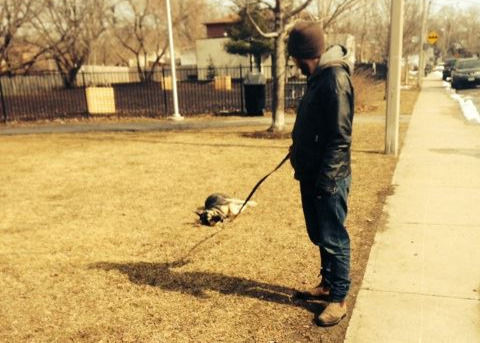
What did this mean for me as Libby's handler? It meant I had to be thoughtful about how I organized our days and where we walked. Going to the park was still worth it but as you can see in the photo above, I had to schedule in some extra time for her to process leaving the park. If I wanted to go do something without her that day, it was better if it wasn't right after a car ride, so I couldn't rush home and then leave her behind.
And if she was really stressed out, I would avoid walking in the neighbourhood on garbage day in order to reduce her exposure to evil garbage bags.
Obi
Obi was more environmentally sensitive than Libby but seemed to handle his frustration better. His default response to anything was to bark and possibly lunge at it so his reactions were more "explosive" than hers.

Most of our walks involved keeping space from other dogs and doing a lot of Notice & Report or Treat Their Feelings in order to counter condition to the stress that he was experiencing. We could let some dogs walk by us but not huskies (sorry huskies) and they had to be on a 6 ft leash; if they were more than 6 ft away from their handler he got much more agitated. He really did not like watching offleash dogs run even if they were not coming towards us.
If we had a stressful walk, he would be very barky during our cooldown fetch session afterwards.

In order to help Obi with his trigger stacking, I did a lot of counter conditioning on our walks. I was also forgiving of more attitude during his cooldown fetch because I understood where it was coming from. We avoided places with off leash dogs and horses.
There was one year where Obi got so trigger stacked that he started reacting to flashing Christmas lights. We took a few days off from big walks and did more enrichment at home, as well as more fetch in the yard. When we resumed walks, he was back to normal.
Perry
Perry is still a baby so I am not sure what his adult profile will look like. He is a very different dog than my shepherds and his stress reaction is to pout and refuse to move. If he gets really upset, he will bite at the leash or carrier, or he will try to run home.

So far the things that upset him the most are loud noises (especially cars backfiring or racing) and being left alone. He's getting better about not getting to say hi and he's not nearly as dramatic about it as Libby was.
When it was warm enough for us to have the screen dog door open, he would charge outside to tell off the cars racing nearby. Now that it's cold and we've closed the door, we are working on "just because you're mad doesn't mean we're going to open the door for you to go yell at cars" using counter conditioning.

I help Perry with his trigger stacking by counter conditioning to loud noises and letting him go home when he gets scared. He's gotten a lot braver as he gets older so it's not common for him to demand to go home but it still takes him a few seconds to recover.
I also make sure he gets compensated for the friends he doesn't get to say hi to.
Struggling with Trigger Stacking?
If this sounds like your dog and you want to help them handle their stress better, here are a couple tips!
Reward Relaxation
After the stressful event, notice what your dog does to calm themselves down. If you mark and reward the "steps" that they take as they calm down, they will start to do those steps faster, and get faster at calming themselves down. This was extremely helpful with Obi.
Take A Break
if your dog is overreacting a lot, it's a good idea to take a break from stressful experiences. Like Obi and the flashing Christmas lights, you might find that taking a few days off helps your dog's brain and emotions "reset".
Counter Condition with Treat Their Feelings
You can also change how your dog feels about the experience by using Counter Conditioning. Essentially, change it from upsetting/scary to good by giving them treats for noticing the thing that upsets them.
Want More Help?
Check out our 1:1 training services and our new Reactive Dog Video Course!


Comments