

3 Tips for Less Stressful Holidays With Your Dog

Updated: Dec 12, 2025
Want to include your dog in your holiday celebrations? Worried that you'll be inviting some canine chaos in addition to canine company? Don't have time for a big involved training plan that will take weeks to get results?
Here are some tips to help reduce the chaos and seasonal stress.

1 - Outlet First, Self Control Second
Make sure you give your dog an outlet for their excitement and energy before your guests arrive or before you arrive at your gathering. This may mean taking them on a fun run at a park or Sniffspot, or taking them for a long sniffy walk on a trail, or playing their favourite game with them until they're nice and satisfied.
Once you've burned some of their energy, do a "cool down" with a little more self-control. Do a refresher of well-rehearsed obedience cues and tricks. Slowly ask them for more control and give them less outlet until they are able to be patient. Watch for signs that your dog is calming down - a full body shake, slower breathing, offering calmer behaviours like sit or down or settle.

This can take some time! I budget at least 30-60 min for this outlet and cooldown. With teenage Libby and Obi, it was closer to 1-2 hours to really get the gremlins out (luckily one of Obi's favourite activities was "helping" me shovel). Teenage Perry has gotten used to weekly family dinners so he walks us around the block for 10-15 min to pee on all the things before we go inside now.

2 - Use Tools to Your Advantage
Leashes, harnesses, and gates can really help you control your dog and your space. In dog training we often call this "management" and it's the first thing I like to cover with clients. If you can set up a gate to prevent your dog from reaching things or people they shouldn't, that means you don't have to micromanage them!

Libby was an incredibly determined counter surfer. When she was a teenager, I had to keep her on leash to keep her from snatching snacks. As she got older, she developed a nice "public persona" when visiting people's homes and did not snatch their snacks, so she got a little more freedom. I remember taking her to a Thanksgiving dinner and she figured out which human was most likely to give her treats and she sat very politely but determinedly beside this person for the entire meal. No begging! Just sitting and waiting very patiently.
Perry is currently in his marking phase. When we are distracted and eating during family dinner, we tether him to a piece of furniture so that he can't wander off to pee on something. This helps me relax a little, otherwise I'm constantly on guard for where my little squirrel has wandered off to and what crimes he's up to.
We use gates to protect our decorations. My senior cat Remi seems determined to climb the Christmas tree. He loves to knock things off of shelves and tables and counters. I am certain that he would jettison most of the ornaments to the floor. So we set up an exercise pen around our tree and he can't reach it. This also keeps the puppy away - win win!
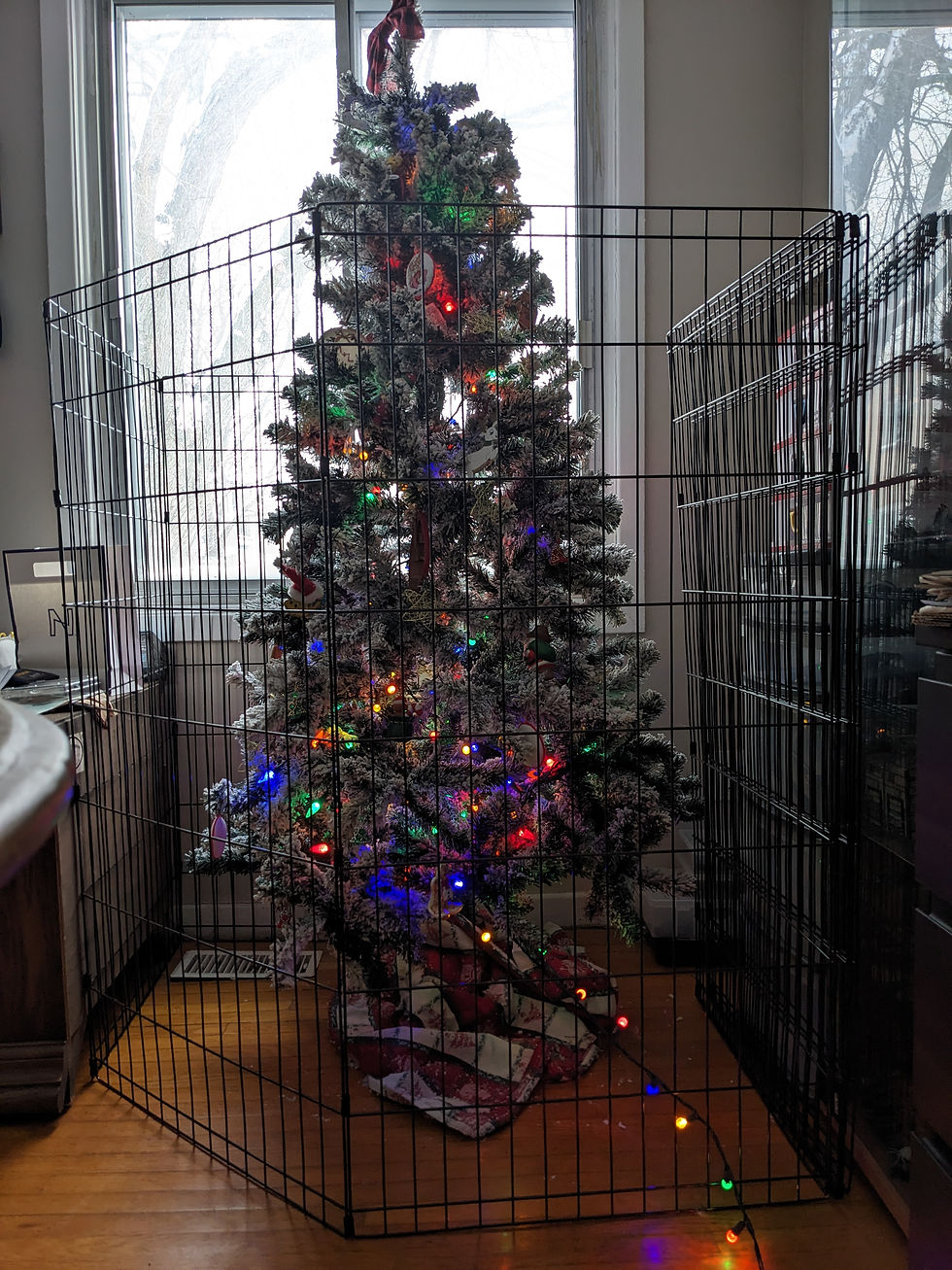
I also love using gates when there are small children involved. I only let them interact if there is one adult focused on and within arm's reach of the child and a different adult focused on and within arm's reach of the dog.
3 - Take Breaks!
Breaks are great! When in doubt, take your dog outside or to another room for a break. If your dog is more sensitive, they may need more breaks or longer breaks.
Perry is a very human social little dog but he still gets overstimulated and needs breaks. He will usually come to me and lie beside me for a break from additional stimulation, especially petting from other people. We take him for a walk every 2-3 hours so he gets to reset his little brain by doing some sniffing. If we're home, we'll put him in his pen and give him a delicious chew so he can decompress a little bit.
Libby was stressed by the car ride but loved group gatherings so she needed a break before and after every car ride, but did not want to leave the gathering once we were there. I learned not to argue with her :)
Obi was the easiest to give breaks to because he loved his crate. So when he got overstimulated, we'd take a crate break.

So there you have it:
Burn your dog's energy before the event
Use harnesses, leashes, and gates to manage your dog while you're distracted
Make sure your dog gets breaks from all the excitement
Want to integrate your dog into your holidays? The best time to start training is now. We can go over some quick strategies for this year and then get you started on some key skills that will pay off over the longer term.
Start with a Virtual Consult and relax a little this holiday season.


Comments